
Chasing joy
In ALL of life's seasons

I’ve recently touched on Doug’s travel history. But what I didn’t write was that I, too, had the privilege of travelling for work in young adulthood.
Doug had seen the South Pacific, Hong Kong, and Japan. I’d visited parts of Europe, Africa, and Israel. We’d both been to New Zealand and places in the U.S. Those experiences shaped us deeply as young people, opening our eyes to the wider world, its beauties and problems, joys and sorrows. And when we began dating, our mutual enthusiasm for travel proved an immediate bond, growing our attraction to one another. Once we were considering marriage, I recall wistful conversations about hoping to instill a similar love for travel in our children someday.
When our three kids came along, such travels, of necessity, became rare. But I remember encouraging our kids in conversations around the dinner table to try to find ways, as we had, to “travel on someone else’s dime,” our conviction being that work travel exposed you to realities of life, people, and cultures in other places that tourism never would. We were both proud that all three managed to do so, and we hoped that one day, we might have a few more adventures together of our own.
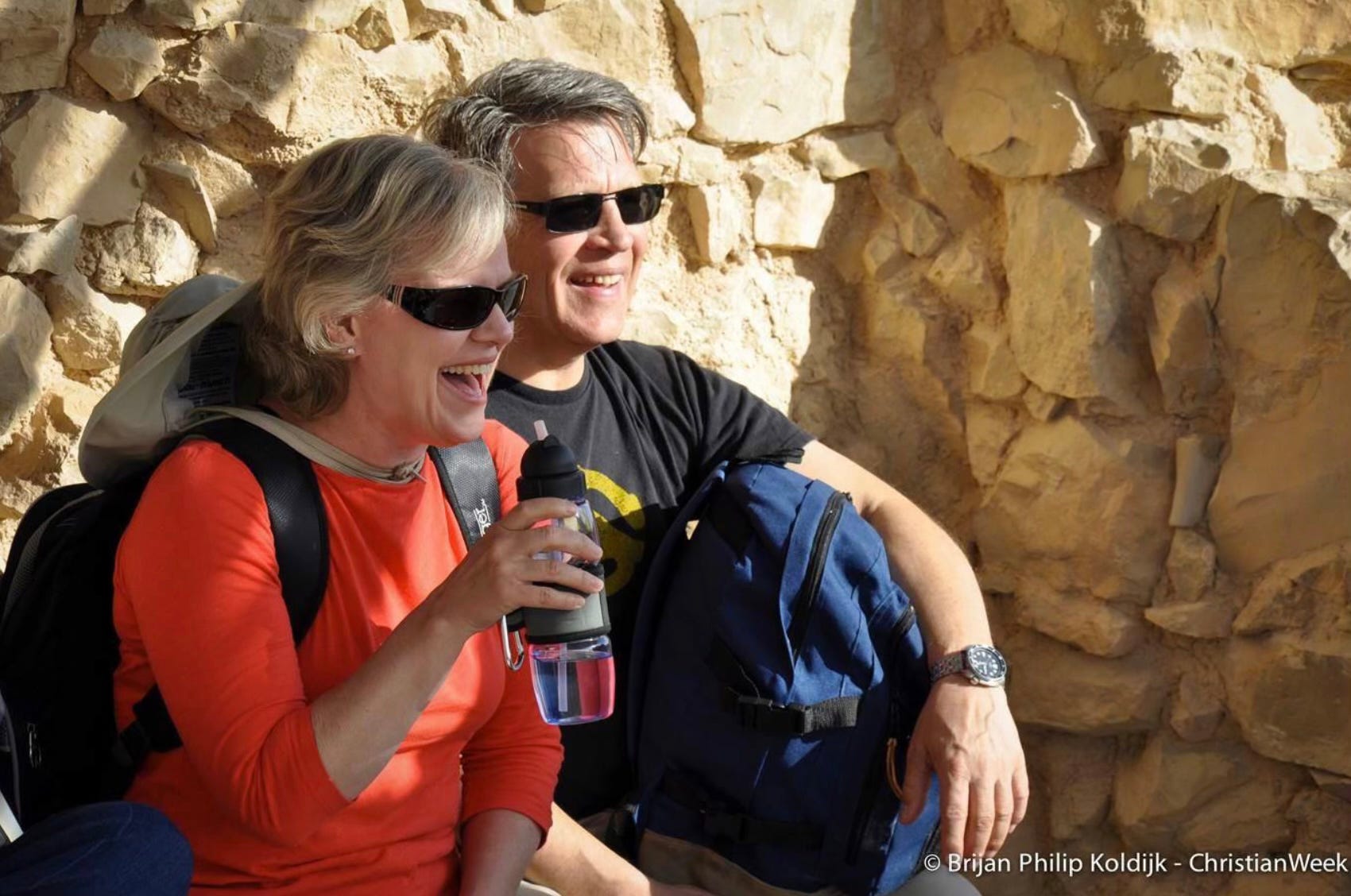
Travel became less frequent once our kids came along. But here is a favourite photo from a rare, work-related trip (to Israel) that we were privileged to take together in 2013.
Living with a sense of urgency
When your life partner lives with a progressive neurodegenerative disease, one that you’ve been told has a relatively short prognosis (five years in our case), life takes on a sense of urgency.
You know that, however your loved one might be today, this is the best they’re ever going to be again. Tomorrow, they might be stable or they might be worse, but they will not be better. Neurons are dying steadily, and the speed of change you witness in your partner can be breathtaking. While you know the outcome of the disease is death, you don’t know what tomorrow, or next week, or next month will bring in the march toward that eventuality. The urgency comes from wanting to make the most of today, knowing you’re never coming back, not even to this place of already diminished cognitive ability.
“It is what we make out of what we have, not what we are given, that separates one person from another,” writes Nelson Mandela in Long Walk to Freedom.
Since getting Doug’s dual diagnosis (frontotemporal degeneration and corticobasal syndrome), I’ve felt an increased urgency to make the most of what we have each day, and also to try to make some as-yet-unfulfilled dreams come true. As his life partner and the one who vowed to care for him in health and sickness, I am acutely aware that his life is increasingly in my hands. I feel a sense of responsibility to steward well whatever time he has left, and that we have left together.
Sometimes that looks like prioritizing time and resources for family and friends. Sometimes it’s something else. But it’s always driven by the desire to honour what I think Doug would want or once wanted.
The reality of my husband’s illness is such that the sorts of adventures we long ago thought we might have in our retirement years are not safe to pursue.
But the wise teacher of Ecclesiastes reminds me that, “There is a time for everything, and a season for every activity under the heavens.” In other words, life is lived in seasons, and each season has its purpose.
Living with intentionality
Before Doug got sick, an Alaskan cruise was something we often talked about doing “someday.” So when my sister and brother-in-law invited us into their plans last spring to fulfill their similar dream, it seemed like the perfect opportunity.
Determined to live this season with intentionality, I consulted with family and friends (Was this a good idea? Would there be enough to see if Doug didn’t feel up to getting off the ship for excursions?) and the cruise line (Could they make certain, needed accommodations?), and last spring booked us on what I hoped would be a safe, two-week adventure.
The cruise took place in July, and I’m glad we went. Airports proved stressful for Doug, particularly going through security, but once we were aboard the ship, he rose to the challenge of participating in the face of so much that was unfamiliar.
Each day, he would ask, “What are we doing today?” When told of our plans, he would invariably respond, “No. I don’t want to do that.”
“Okay,” we learned to say.
But within a half hour, he would generally indicate that he’d come around to the idea by saying, “So, when are we leaving?”
It became my greatest joy during those two weeks to see how, again and again, his heart overruled his head, putting me and family-who-are-also-dear-friends first, before his comfort, anxiety, lack of understanding, or fear.
Whale watching, visiting glaciers, riding the White Pass and Yukon railroad, and exploring the Alaskan rainforest and tide pools were all experiences we four had together.


Clockwise from top left: Whale watching on a rainy day in Juneau. 2: My brother-in-law, Dan, and sister, Sandy, with me and Doug on the beach in Icy Strait Point, Alaska. 3: A favourite shot of Doug on the deck of our ship. 4: With my sister at the Hubbard glacier.


Clockwise from top left: Doug and I ride the gondola at Icy Strait Point, Alaska. 2: View from the White Pass and Yukon route train in Skagway. 3. Trees along the trail in Icy Strait Point. 4. Starfish and sea urchins in the tide pools.
Our explorations, while of a calmer nature than the kinds of adventuring we once did, felt deeply good, and our photos are sure to spark happy memories in the future. My sister and brother-in-law were wonderful with Doug, and their willingness to spend time with him to give me a break was a gift. But there was also sadness amidst the joy; I was acutely aware of just how different this adventure felt from any of our previous travels, because of how different Doug is.
When the cruise was over and we returned home, I felt something akin to “post-Christmas letdown.” Eventually, it dawned on me that what I was feeling was the result of realizing that our travelling days are likely over. We have reached the stage in the progress of my husband’s disease where he is happiest at home, with all of its familiar comforts and routines.
And so begins another season.
“Joy is not the absence of sadness or suffering; it is our awareness of the enduring presence of God in all things and at all times. Joy is the settled assurance that God is with us and for us … It is the bold confidence that ultimately everything is going to be all right, accompanied by the determined choice to praise God in every situation in the present.”
– Finding Jesus in the Storm, by John Swinton, p. 82
"However your loved one might be today, this is the best they’re ever going to be again." These earlier words are precisely why the last lines of this piece resonate deeply. I'm so glad you have this memory of time spent together.
I’m so glad you went.