
When people care
And when they don't

Early last Saturday morning, well before the sun had risen, I opened my weather app to discover the day held the promise of sunshine. After what felt like an especially long winter, that forecast made the thought of some fresh air and a brisk walk alluring.
I’ve always been a morning person. Indoors, I cherish the calm, the quiet, the dark of early mornings alone. But spring has the power to pull even the most devoted hermit out of doors.
The minute Doug was up, I talked him into getting dressed and walking the two-kilometre distance with me to a local bakery. It wasn’t a particularly hard sell.
Frontotemporal degeneration (FTD) has dramatically changed his tastes. While he once spurned desserts, now he craves sweets daily. For months before his diagnosis, I battled with him over his eating habits, not understanding the reason for the change. I worried something was happening to him, thought he’d given up, thought he no longer cared about his health, and therefore maybe no longer cared about me.
But since learning the reality of his incurable, progressive, neurodegenerative disease, I mostly force myself to turn a blind eye. If it were me who was dying, I think, I’d want to eat the chocolate pie.
Since I stopped nagging him more than a year ago, our relationship has improved. We fight less, he seems consistently happier, and his trust in me is unfailing. So am I making the right choice? I hope so. Because sometimes it makes me crazy to think about what all the junk is doing to his body. When we go to the grocery store, he invariably adds an Oh Henry to the cart. Walk through the baked goods, and he’s reaching for danishes. At the checkout, it’s licorice allsorts. I’ve started making my own ice cream using organic cream from the health food store to keep him away from the ice cream aisle. I tell myself it’s the least I can do.

Photo by Bill Craighead on Unsplash
Suffice to say, I know my husband’s weaknesses. And last Saturday, the offer of a freshly baked cinnamon bun accompanied by a good cup of coffee proved a compelling enticement for an early walk. (I didn’t tell him the buns from this bakery are made with fresh-milled, organic, whole wheat flour.)
Down the street, through the park, across the bridge spanning the still-icy Assiniboine River, up a few blocks, and we arrived at the Tall Grass Prairie Bread Company. It was not yet 8 o’clock. The streets were still quiet, and the morning held a feeling of fresh hope. We mostly rambled in silence as we tend to do these days. Conversation gave way to quiet companionship. I loved that outing.
At the bakery, we purchased two cinnamon buns wrapped in wax paper and two cups of steaming coffee, then took our reward/breakfast outside to sit at a nearby picnic table in the warm sun.
The street was silent, but we weren’t alone. On a nearby bench, a man sat hunched over his own paper cup clutched between his hands. His straggly grey hair and beard gave him the look of someone who hadn’t had a cut or a shave in years, a shower in weeks, and a hug in longer. I guessed he was about the same age as my husband.
Unwrapping my cinnamon bun, I immediately felt guilty. How could I eat when he was not? The bun was huge, too much for me, so I broke it in half and approached the man, extending my offering.
“It’s too big for me,” I said. “Would you like some?”
He shook his head. “No, I can’t eat that. It wouldn’t be good for me.”
He stood and shuffled off, his pants drooping, seeming three sizes too big against his too-skinny legs.
I’m making assumptions. I know nothing about the man other than what I could deduce from his appearance. But he seemed sad and lonely. Uncared for. It occurred to me that the only thing separating my husband from that man was people who care.
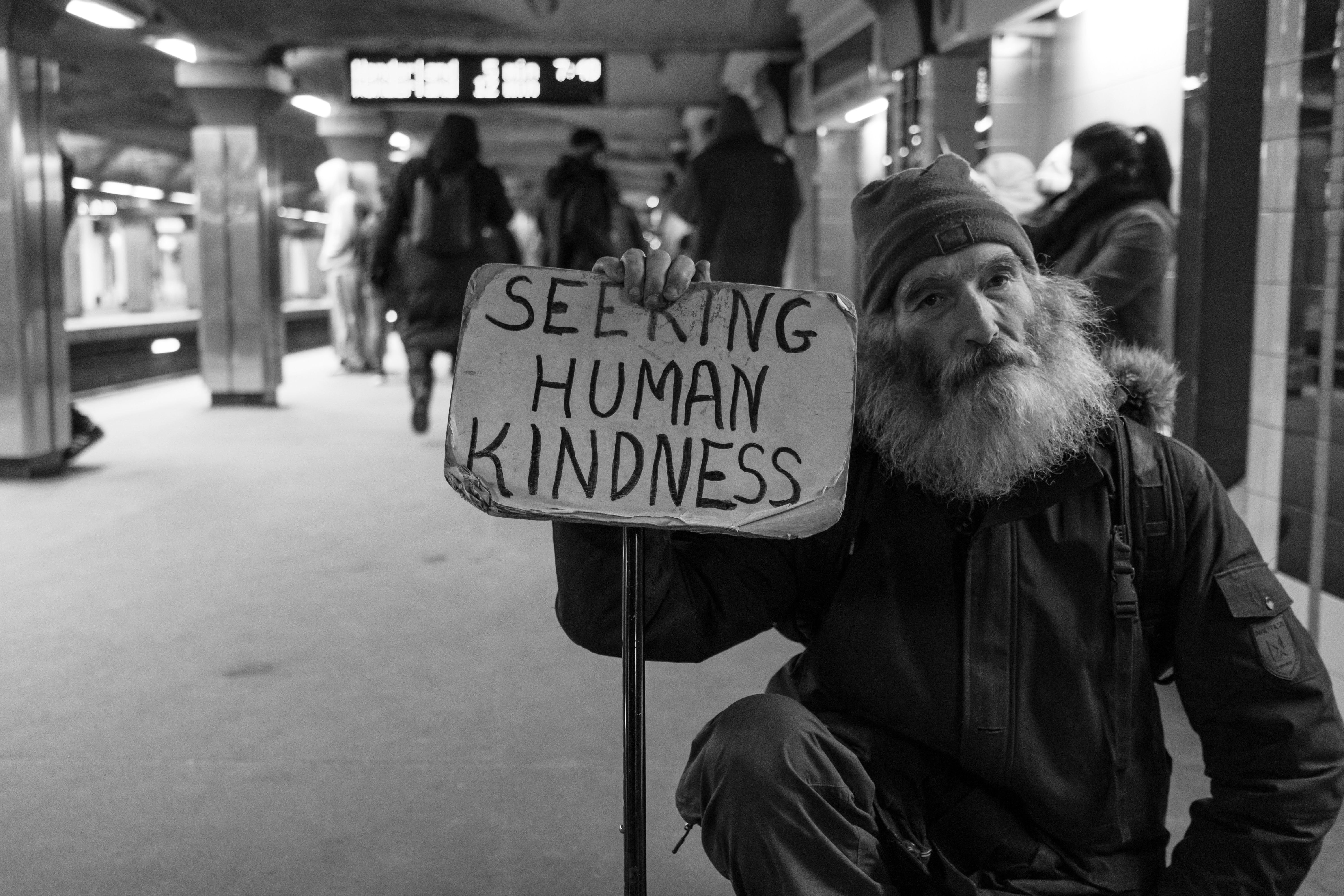
Photo by Matt Collamer on Unsplash
A study in contrasts
At 73, and in the mid-stages of dementia, my husband remains a handsome man. He is clean and well-groomed. Today, that is sometimes only true because I remind, coax, and even cajole him to shower, to use deodorant, to brush his teeth, to trim stray nose hairs, and to shave. If he reaches for the same clothes too many days in a row, I whisk them off to the laundry when he’s not looking and lay out fresh options. Every eight weeks, I take him to the salon with me, and we have our hair cut, sitting side-by-side.
I am not alone in caring for Doug. He has been blessed with Harry, Wilf, Chris, and Al—men from our church who care for him socially, emotionally, and spiritually. They call on him for walks or drives, to watch a game together, or to go out for a meal.
Bob, a friend from our building, regularly joins Doug to watch a hockey game in our condo or invites him to watch one in his. He also accompanies Doug to volunteer at the biweekly food bank at our church, allowing my husband to continue to find meaning and purpose in serving others.
When these friends spend time with Doug, it not only gives him joy and a sense of his continuing value, it provides me with respite.
Family also plays a significant role. Two mornings each week, we pick up our three-year-old grandson from preschool and bring him to our home, where he joins us for play, lunch, stories, a nap, and more play before it’s time to hand him back over to his parents. Helping care for him is good for both of us—it provides structure and joy to our week, and allows us to feel we are making a difference.
Wisdom from astronauts
Doug and I watched the press conference during which the Artemis II Astronauts spoke about their experiences as four human beings who travelled farther from the Earth than anyone ever had before. Canadian astronaut Jeremy Hansen reflected on how we need others to do big things. Being so far from home, he said, “We just leaned into what we had. We leaned into each other.”
Christina Koch added, “We’ve done this together. We took your hearts with us. And your hearts lifted our hearts.”
I am well aware my husband is dying. I see the evidence. Caring for him is a big thing, maybe the biggest thing I’ve ever done, or will ever do. Concealed grief is my constant companion. But it comforts me to know he is dying well. Because even as he dies, he is living well. He continues to experience friendship and purpose. He knows his life has value and meaning. He knows he is deeply loved.
Living well, like dying well, is not something we can do on our own. It takes a community. We have found a community who cares. And their hearts lift mine.
I count my blessings every day.
“I’m realizing that I can feel God’s presence easily and joyfully in moments of delight. I find him in the light but lose him in the dark. When I’m anxious and reach for him, I can’t touch him or sense his reality. That’s when he comes in the guise of other people.”
- Luci Shaw, God in the Dark: Through Grief and Beyond, p. 240
Look at the two comments above mine. Both of them are "sending love ❤️" and they actually think they've done their bit here. That's your post. The whole point of your post, by the way. Doug's got Harry coming by with the car. Bob shows up to watch hockey with him. They go to the salon together every eight weeks, I mean actually sit side by side. That guy on the bench had none of that. A heart emoji from some stranger two provinces away isn't that. That's not what you're describing. They won't even remember your name Tuesday.
The line about walking in silence, by the way. Conversation giving way to quiet companionship, whatever you called it. That's the part I couldn't stop reading. I hope you know what you were describing there.
The guy who said "it wouldn't be good for me" and walked off, I keep thinking about him too. He had his own shit going on, whatever it was, he wasn't telling you. Which doesn't weaken what you're saying, actually it makes it worse. He'd need someone who knew his stuff the way you know Doug's. Nobody here is signing up for that.
Sweet tooth isn't him giving up by the way. bvFTD chews up the orbitofrontal cortex, the satiety signal stops registering, the brake's just gone. That's the whole mechanism basically. You figured it out before the neurologist probably did.
The fresh-milled flour bit, and you didn't tell him. That killed me.
Thank you, once again for expressing the journey so well. I, too, am attempting to help my loved one live well. Travelling to be with family is helping us do that. Dementia is evident altho’ as yet , not officially diagnosed. Ours is a slower journey than the one you are living, nevertheless, many of your artfully expressed thoughts are so familiar. I am grateful for the support you have in your community and pray that ours will evolve.