
Medication mercies
God's good gifts delivered in pharmaceutical form

Squashing my emotions and ignoring my pounding heart, I sat forward in my seat, intent on staying focused. I wanted to absorb every bit of information Dr. S. communicated. Why hadn’t I thought to bring along a notebook?
That day in January 2025 would turn out to be the first and last time I ever met a neurologist. I had gone into the appointment expecting bad news; hours of research convinced me my husband had frontotemporal dementia (FTD). I had invited our daughter along because I was afraid I might not retain everything I would need to retain. She could be a second set of ears.

Photo by kyle smith on Unsplash
At some point, I glanced over at her. She, too, was focused intently. Good. Some of the information Dr. S. was delivering was entirely unexpected.
He spoke slowly, carefully, kindly. He told me my husband has corticobasal degeneration (CBD) and described the symptoms typically attendant with that condition (none of which we had yet seen). “If you Google it, you’ll only get confused,” he said.
He told me to get our affairs in order. He said time was short, and in the time we have left, I would need to become my husband’s “conscience and authority.” Dr. S. said people with Doug’s disease sometimes get into trouble with the law.
He told us he would be retiring and shuttering his practice in a few weeks, so this would be our only appointment. After that, we would be back under the care of our primary care physician. No, he wouldn’t refer us to another neurologist. “Specialists don’t make referrals,” he said when I asked.
The doctor told us there are no medications or treatments to reverse, slow, or halt the progression of my husband’s disease, a subtype of frontotemporal dementia (FTD). “But there are medications to control symptoms,” Dr. S said. “SSRIs—antidepressants can be helpful with symptom management. I will send a note to your family doctor. He can oversee prescriptions.”
He didn’t tell me which symptoms the SSRIs control. And in that moment, I didn’t think to ask. Numb, I just nodded and said, “Thank you.”
To date, I am still not seeing signs of CBD. Maybe it just hasn’t emerged yet? Or maybe it’s a misdiagnosis? That is my hope. Only time will tell.
In the meantime, there has been more than enough to cope with in adapting to the symptoms of Doug’s primary progressive aphasia (PPA) and FTD.
Losing words was my husband’s first and most troubling symptom. But personality changes quickly became more and more apparent—apathy, loss of empathy, declining executive function, loss of ability to plan, reason, and follow through, decreasing social filters, an obvious increase in anxiety, obsessive-compulsive behaviours, bizarre mania at times, and occasionally, perseveration.
By January 2026, one year post-diagnosis, I was starting to wonder which symptoms might be controlled by the medications Dr. S. had mentioned, medications we hadn’t yet embraced.
Reluctant
Neither Doug nor I are quick to pop pills. We were both raised by mothers who were reluctant to even take a Tylenol for a headache. That kind of attitude rubs off on you. We’ve both been fortunate to never need much more than the occasional antibiotic, asthma or allergy meds. I take weekly medication for osteoporosis. Beyond that, the only pills either of us swallowed on any sort of regular basis were vitamins—B12, D3, fish oil, and the like.
The idea of requesting brain-altering medications for my husband troubled me. I waffled. It felt like a weighty decision to assume such a responsibility for someone else, and a decision with an uncertain outcome. Besides, weren’t antidepressants for people who were depressed? I saw no indication of depression in him. With anosognosia, he seems blissfully unaware of the progress of his disease or even that he has a disease at all.
But as strange behaviours became more and more his norm, and more and more distressing to observe, I thought about speaking to the gerontologist, who was by then overseeing Doug’s care. Ultimately, it was our kids who encouraged me to set aside my doubts and talk to the doctor. They affirmed that if it were possible to alleviate some of his symptoms, it might also help to keep him socially active for as long as possible.
“Dad’s brain is already altered, Mom,” said one.
“If it were me behaving like this, and medication could help, I’d want that help,” said another.

Photo by Towfiqu barbhuiya on Unsplash
In early March, I spoke to our family doctor to let him know I planned to ask the gerontologist if there was something that might help Doug’s symptoms. “I can give you something right now,” he said, and prescribed Quetiapine, instructing me to start with a half-dose for a few days before increasing to a full dose. Gratefully, I gave Doug his first half-dose the following morning.
He would be off it within a week.
Shortly after giving him his first half-pill, in what I believe was a “God-thing,” I happened across this article by Vance Frost, and became alarmed when I realized the drug I’d just given my husband was a powerful antipsychotic, one that carries real risk. I reached out to Frost with questions. He explained that SSRIs are not just for depression; “In FTD, they’re not treating mood,” he wrote. “The frontal lobe loses serotonin early, and that’s what’s driving the OCD and the anxiety.”
Within a few days, I asked my dementia coach and then the gerontologist about Quetiapine. They confirmed Frost’s point; Quetiapine is a “big gun,” they said. There were other, gentler approaches we could try. The gerontologist discontinued the Quetiapine immediately and started Doug on Sertraline.
Every time he asks me what those little yellow capsules are for, I say, “They’re for your brain. That pretty young doctor you liked recommended you take them.”
It took a few weeks, but the change in my husband’s behaviour has been remarkable. It’s like the sharp edges of his symptoms have been rounded off. Symptoms are still there, but he is calmer, less anxious, more like his old self.
Before Sertraline, I had been thinking our days of caring for our grandsons were drawing to a close. Spending time with little ones seemed to cause Doug stress. I didn’t want that for him, and I didn’t want our grandsons to have bad memories of their grandfather. But within a few weeks of starting the medication, he once again remained relaxed in their company. He clearly enjoys them, and they him. It is a gift. I am grateful.
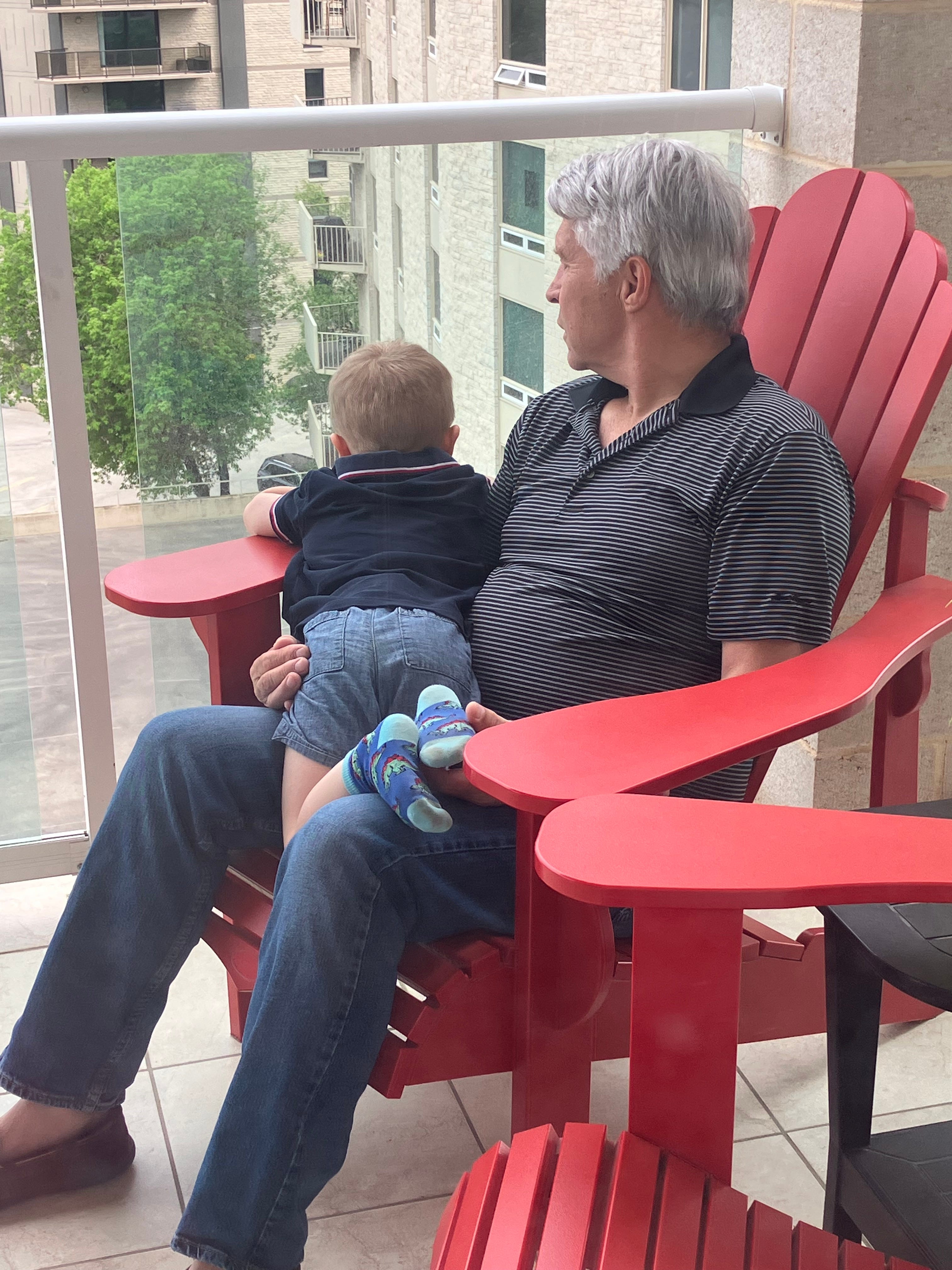
Doug and our littlest grandson on our balcony this week, watching the garbage truck in the parking lot next door.
There have been other improvements. I haven’t felt the need to hand out one of these cards in months. I am less on edge when we’re in public. I’m no longer as worried as I was just months ago about what he might say or do. I am sleeping better at night. Sertraline is buying us time. Good time.
I feel like I can breathe again. And it seems like Doug can, too.
“So much of faith has so little to do with belief, and so much to do with acceptance. Acceptance of all the gifts that God, even in the midst of death, grants us.”
- Christian Wiman, My Bright Abyss, 178.
Those little yellow capsules. The grandson out on the balcony, gawking at the garbage truck. That's the whole picture right there, Patricia, the one you came this close to not having left.
When that email landed I just confirmed what you'd already half-figured out yourself. Here's the thing though, it's not in the post and it's worth saying. Sertraline wasn't slipped to you as the "gentler option." For frontotemporal it's the front of the line, has been for ages, that's just how it gets prescribed. Quetiapine's the one wearing an FDA black box since 2005, a straight-up mortality warning, and people with FTD tend to come apart worse on that whole class of drug than most. So "I can give you something right now" basically dropped the single most dangerous one of the lot into your hand. The right stuff was one phone call away. Nobody could be bothered to make that call until you were the one who grabbed the phone.
And this part isn't sad, it pisses me off. Not because the doctor's some villain. Because the pill got spat out on autopilot, on reflex, instead of anyone sitting down for one second to think about Doug specifically and his diagnosis specifically. Loading the man up with one more drug is the path of least resistance, so the path of least resistance is what you got.
Only you were looking at something else entirely. You were hunting for a way to lift even a little of the weight off the man you love. All these years beside him, you know him better than any machine in that room ever could, and you smelled that something was wrong long before it dawned on anyone behind the desk. Call it God's hand, I won't argue. It just worked that day through you sitting down, reading, getting uneasy at the right moment, hitting the brakes in time. The hands were yours.
Anyway. Your mum and her one lonely Tylenol. Looks like that one really stuck.
Patricia, thank you for sharing your and Doug's journey. You are teaching me so much; about dementia, yes, but also about faith, life, and love. I'm so very grateful this medication is helping with his symptoms, and allowing for more small moments of joy and wonder.