
Remembering to breathe

For three months, I held my breath.
I needn’t have. I know that now. Hindsight is always 20/20.
But from mid-November, when my husband announced he was “never going back to that place”—meaning the adult day program (ADP) for which we’d waited months on a waitlist for a spot to open for him—until one week ago, when I finally concluded that he had indeed adjusted to his weekly “seniors’ club,” I wondered if I would be back to square one in my efforts to build one-full day of weekly respite into our lives.
Because the thing about caring for a loved one with dementia is that our present circumstances are always coloured and complicated by our history with the person we care for. So it’s easy to overestimate our person’s cognitive, emotional, and social capabilities, and to underestimate the scope of the changes occurring unseen, deep inside their brain.

Photo by Fabian Møller on Unsplash
Case in point
Doug’s profound resistance to going to the ADP was so unlike him. But then, dementia does that; it changes personalities in unexpected ways, especially dementia of the frontotemporal type.
My husband has always been a social person, someone who delighted to be around others. He made friends quickly and easily. People gravitated to his thoughtfulness, his relaxed good nature, his generosity, loyalty, and quick wit. I remember marvelling at his diverse group of friends when we were dating; people he’d met in all kinds of circumstances and from all walks of life—childhood friends, college buddies, colleagues, and clients among them.
He never had trouble walking into new situations—even when he was the odd man out, like when he signed up for karate lessons with our then six-year-old son, Mark, and Mark’s friend Tyler.
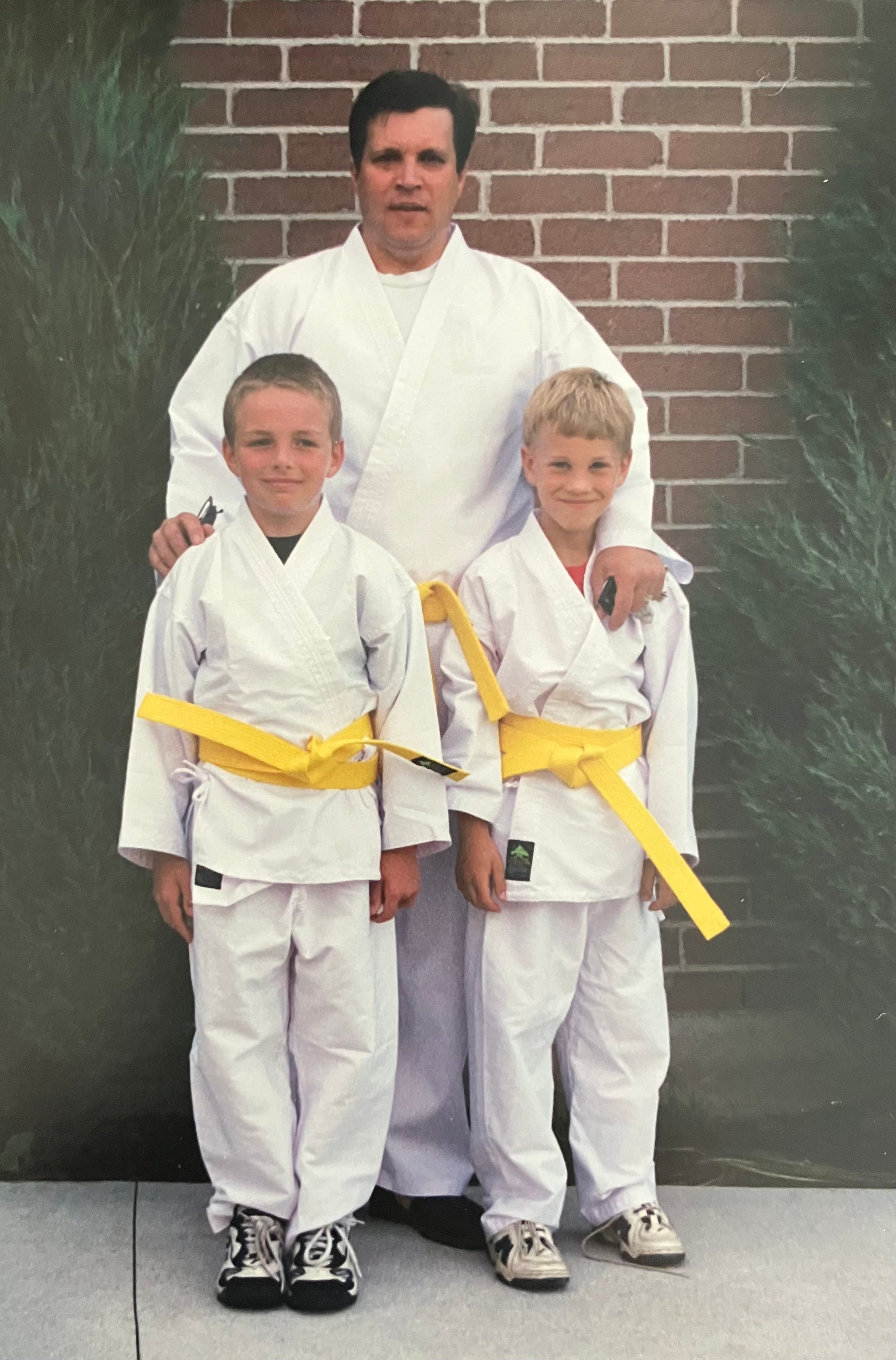
From left, Tyler, Doug, and Mark. They had all just earned their yellow belts.
For months, Doug was the only adult in the class, surrounded by small children—although eventually, other parents, emboldened by his example, joined too. (Doug and Mark stuck with karate, earning their brown belts together, until Mark left home for university. Doug continued on his own, eventually earning his black belt.)
Disbelief, dismay, despair
So you can imagine my disbelief, then my dismay when, after only his second time at his “seniors’ club,” he announced he was never going back.
“I can’t do it anymore,” he said in mid-November as I greeted him at the door after his first solo visit to the day program. (I’d gone with him the previous week, so I knew it was a lovely, gentle experience and that he had been warmly welcomed and received.)
He was clearly distraught, but primary progressive aphasia prevented him from articulating exactly why he didn’t want to go back, other than to say repeatedly, “Everyone’s so old.”
Doug’s anosognosia may prevent him from recognizing the changes in himself that have come with neurological disease, but he has no difficulty perceiving frailty in others.
My heart broke for him. Everyone who attends the Friday program lives with dementia, and yes, many of the participants are older than Doug. Spouses of people living with frontotemporal degeneration (FTD) know that while “the system” lumps our loved ones into programs and facilities for people with other types of dementia—primarily Alzheimer’s—our people often don’t “fit,” due to the unique nature of their symptoms and because FTD strikes younger. (The average age of onset is from 45 to 64.)
After that second week, I managed to talk him into going back for a third; I desperately wanted to be able to count on that weekly break. “I need this time to get things done,” I told him. “It’s fun! The people are lovely! It can be your thing! You can be a blessing to the older folks. Maybe God’s got you there to be a helper. Think of it like your job, you’re there for a reason!”
I spoke to the program coordinator, who assured me that while he was quiet in the program, he participated.
And I prayed.
But after his third visit, he again refused to go back. And over the next three days, he worked us both into such a state of despair over his refusal that I reached out to our pastor via text message for help.
Our pastor, God bless him, made time the same day and came to our home to visit. He sat with us both and calmly, quietly listened. He tried to get Doug to express why he was feeling the way he was feeling. He reminded my husband of his long love for me. He assured Doug of my love for him and said that I believe his participation in the program would be good for both of us.
As we sat together, I suddenly had an idea. “What if you agree to go until February? Just until February, and then we can re-evaluate.”
Doug considered that. “I only have to go until February?”
“No,” I clarified. “Go until February. And then if you are still unhappy, we can re-evaluate things.”
“Okay,” he said. “Until February.”
I started holding my breath.
As the weeks ticked by
He never mentioned February again. And of course, neither did I.
When he came home from his “seniors club” on the third Friday in January, he declared his day “good.” The following week, he described it as “fun.”
But as February drew closer, I could sense my tension rising. Would he remember our agreement? Would he want to talk about quitting the ADP? What would I do then?
When the month turned over, Doug made no mention of our conversation, and on Friday, February 6, he went off to his day program. Happily. Willingly.
At day’s end, when I asked him how his day had been, he smiled and said proudly, “Good. I helped some of the ladies put on their coats.”
A gift
To know I have one day each week to myself that I can count on to run errands without dragging Doug along, to take care of the myriad details of our lives, to work, to spend time with a friend, or just to do something for me, feels like such a gift.
It’s a gift made possible only by knowing he is safe and happy. I am relieved. I am grateful.
Sometimes life places obstacles in our paths that feel like enormous hurdles. No—more than hurdles, they can seem like mountains to climb, one excruciating step after another. In the midst of the climb, we might be tempted to despair. But we can surmount them.
How?
We keep our eye on where we know we need to go. We pray. We ask for help along the way. We believe in our mission. We never stop hoping. We continue moving forward. And we remember to breathe.
*
Patricia we become interlopers with you, seeing your circumstances and response, then applying that to our own life’s. This mirror is therapeutic and a wisdom offering. Thanks for keeping us on the ride.
Doug is probably very popular at the center. I’m glad you persevered.